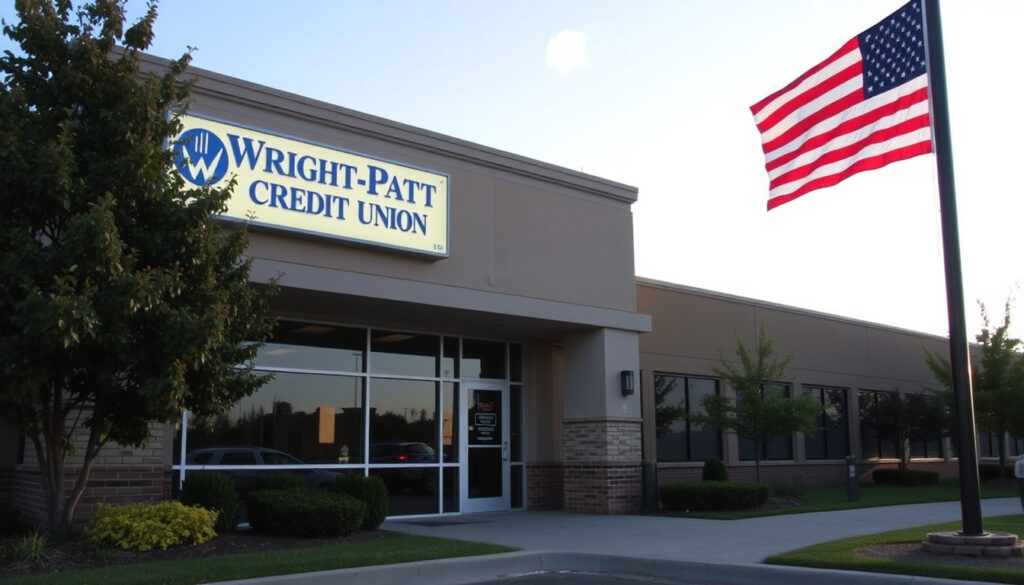
Wright-Patt Credit Union: Is It a Bank? Pros, Cons & Rankings
If you’ve ever wondered whether a credit union could be a better fit for your wallet than a big bank, you’re not alone. Wright-Patt Credit Union (WPCU) is one of Ohio’s largest member-owned cooperatives, serving over 265,000 members with $5.4 billion in assets.
Members: 265,000+ ·
Assets: $5.4 billion ·
Founded: 1936 ·
Branches: 25+ ·
Headquarters: Beavercreek, Ohio
Quick snapshot
- Not a bank — a federally insured credit union (WPCU cooperative definition)
- Founded in 1936, headquartered in Beavercreek, Ohio (Wikipedia credit union profile)
- Deposits NCUA-insured up to $250,000 (WPCU NCUA coverage)
- Exact 2024 ranking among all Ohio credit unions varies by source
- Current loan and dividend rates change frequently
- 1936: Founded to serve Wright-Patterson Air Force Base personnel (Wikipedia growth data)
- 2023: Assets surpass $5 billion, membership exceeds 265,000 (Wikipedia growth data)
- Continued expansion of shared branching and digital services
- Potential to rank among top Ohio credit unions for member satisfaction
| Attribute | Value |
|---|---|
| Full Name | Wright-Patt Credit Union |
| Abbreviation | WPCU |
| Headquarters | Beavercreek, Ohio, United States |
| Founded | 1936 |
| Type | Federally insured credit union (cooperative) |
| Assets | $5.4 billion (2023) |
| Members | 265,000+ (2023) |
| NCUA Insured | Yes |
Is Wright-Patt a bank?
No — Wright-Patt Credit Union is not a bank. It’s a federally insured credit union, which means it operates as a not-for-profit financial cooperative owned by its members, not by shareholders. As WPCU itself explains, WPCU cooperative definition: “We are a member-owned financial cooperative, not a bank.”
Definition of a credit union vs. a bank
- Banks are for-profit corporations run for shareholders; credit unions are not-for-profit cooperatives run for members (WPCU ownership model).
- Each credit union member gets one vote in board elections regardless of how much money they have deposited (WPCU member voting rights).
- Profits are returned to members through lower fees, better rates, and improved services — not paid out as dividends to investors (WPCU profit distribution).
Wright-Patt Credit Union’s structure: member-owned cooperative
WPCU’s structure follows the classic credit union model. It was originally chartered in 1936 to serve personnel at Wright-Patterson Air Force Base, and it has since broadened its field of membership to include residents of many Ohio counties and employees of select organizations. The cooperative structure means that every member with a share account is a part-owner.
How WPCU is regulated (NCUA vs. FDIC)
Credit unions are regulated by the National Credit Union Administration (NCUA), which insures deposits up to $250,000 per member — the same limit as the FDIC for banks. WPCU is NCUA-insured, so your savings are protected by the full faith and credit of the U.S. government (WPCU NCUA coverage).
WPCU is not a bank, and that structural difference matters: the same $250,000 deposit insurance applies, but the profit motive flips. Members, not shareholders, benefit from lower rates and fees.
How good is Wright-Patt Credit Union?
WPCU consistently earns high marks for convenience and financial stability. In a MagnifyMoney ranking cited by the credit union, WPCU was named the #3 most convenient credit union nationwide, based on factors like ATM network size, mobile app satisfaction, and shared branching access (WPCU MagnifyMoney ranking).
Financial strength and ratings
- Assets: $5.4 billion as of 2023 (Wikipedia asset data).
- Membership: 265,000+ (Wikipedia membership data).
- WPCU is one of the larger credit unions in Ohio, typically ranking in the top 25 nationally by asset size.
- The credit union says its financial health is strong, with a well-diversified loan portfolio and capital ratios above regulatory minimums.
Member satisfaction and service quality
WPCU touts high member satisfaction, partly because of its mobile app, online banking, and 24/7 customer service (WPCU convenience features). Shared branching lets members use thousands of credit union branches nationwide, and the CO-OP Network provides surcharge-free ATMs across the country.
Product offerings: savings, loans, credit cards
WPCU offers typical credit union products: checking and savings accounts, auto loans, mortgages, home equity lines, personal loans, and credit cards with rewards. The credit union says its auto loans often carry interest rates a full percentage point lower than banks, which on a $30,000 loan over 60 months can save hundreds of dollars annually (WPCU auto loan savings).
For a borrower financing a car, a 1% rate difference is real money — WPCU’s cooperative model directly translates into cheaper credit. The trade-off is that you must qualify for membership first.
The implication: WPCU is a strong contender for Ohio residents and qualifying employee groups, especially if you value low-cost loans, decent digital tools, and a community-focused institution.
What is the downside of using a credit union?
No financial institution is perfect. Credit unions like WPCU have trade-offs that are important to weigh.
Limited branch and ATM network compared to large banks
WPCU has 25+ branches in Ohio, but if you travel frequently or live outside the Dayton, Columbus, or Cincinnati areas, you’ll rely on shared branching and CO-OP ATMs. National banks like Chase or Bank of America have thousands of branches nationwide. WPCU acknowledges that WPCU branch limitation “limited branch locations” are a common drawback, though shared branching helps.
Fewer product options
Some credit unions lack robust investment services, wealth management, or international banking options. WPCU likely offers fewer specialized products than a large bank — for example, you may not find sophisticated trust services or complex commercial lending.
Membership eligibility requirements
To join WPCU, you typically need to live in one of the Ohio counties it serves, work for a partner employer, or be related to an existing member. This is a barrier compared to banks that anyone can walk into.
Membership rules protect the cooperative model, but they also exclude people. If you don’t qualify, WPCU simply isn’t an option.
What are the top 3 credit unions?
When comparing WPCU to the biggest names, context helps.
Navy Federal Credit Union
Navy Federal is the largest credit union in the U.S., with over $150 billion in assets and more than 13 million members (Wikipedia Navy Federal assets). It serves military members and their families.
State Employees’ Credit Union (SECU)
SECU, based in North Carolina, is the second largest, with assets above $50 billion (Wikipedia SECU profile). It serves North Carolina public employees and their families.
Wright-Patt Credit Union’s position among peers
WPCU, with $5.4 billion in assets, ranks roughly among the top 25 U.S. credit unions. In Ohio, it is one of the largest. For perspective, the top three by asset size are Navy Federal, SECU, and Boeing Employees’ Credit Union (BECU). WPCU is smaller but still a significant player in the Midwest.
Six facts, one pattern: size often dictates digital sophistication and branch reach. WPCU cannot match Navy Federal’s scale, but its local focus and convenience ranking (third nationally) show that size isn’t everything.
What is the richest credit union in the United States?
The richest credit union by total assets is Navy Federal Credit Union, with over $150 billion (Wikipedia Navy Federal assets).
Navy Federal Credit Union: asset size and membership
Navy Federal serves the military community and has grown to be larger than most U.S. banks. Its asset base is nearly 30 times that of WPCU.
Other top credit unions by assets
After Navy Federal come State Employees’ Credit Union ($50B+), Boeing Employees’ Credit Union, and Pentagon Federal Credit Union. All are national or regional giants (Wikipedia credit union list).
Where Wright-Patt Credit Union ranks nationally
WPCU’s $5.4 billion places it in the top 25 nationally. It is not the richest, but it is one of the larger credit unions in Ohio and the Midwest.
Size correlates with product breadth, not member satisfaction. WPCU’s convenience ranking shows that a mid-sized cooperative can outperform giants on the metrics that matter most for everyday banking.
Comparison: WPCU vs. a typical large bank
Five dimensions, one trade-off: you gain lower fees and personalized service at WPCU, but lose the branch density and product range of a megabank.
| Factor | Wright-Patt Credit Union | Typical Large Bank |
|---|---|---|
| Ownership | Member-owned cooperative | Shareholder-owned for-profit |
| Loan rates | Often lower (1%+ difference on auto loans) (WPCU rate comparison) | Higher average rates |
| Branch network | 25+ in Ohio; shared branching nationwide | Thousands nationwide |
| Fees | Lower, fewer (WPCU fee structure) | Higher maintenance and penalty fees |
| Membership required | Yes (geographic or employer-based) | No restriction |
Upsides
Upsides
- Lower interest rates on loans (auto, mortgage)
- Higher savings dividends
- Fewer and lower fees
- Member-owned; profits stay local
- NCUA insurance same as FDIC
Downsides
- Limited branch footprint in Ohio only
- Membership eligibility restrictions
- Fewer specialized products (wealth management, commercial banking)
- Technology may lag behind top-tier bank apps
Member quotes on Wright-Patt Credit Union
“We are a member-owned financial cooperative, not a bank. Our goal is to help you reach your financial goals.”
— Wright-Patt Credit Union official website (WPCU cooperative mission)
“Wright-Patt Credit Union (WPCU) is a US credit union or financial cooperative headquartered in Beavercreek, Ohio.”
— Wikipedia article (Wikipedia entity description)
The editorial verdict: WPCU is what it says it is — a member-owned cooperative that delivers real savings on loans and lower fees. For Ohio residents who qualify for membership, the choice is clear: switch to WPCU for everyday banking and auto loans, or stick with a national bank if you travel often or need comprehensive wealth services.
Related reading: What is the difference between a credit union and a bank? · WPCU ranked #3 most convenient credit union nationwide
youtube.com, wpcu.coop, wpcu.coop, visbanking.com, patelco.org
Frequently asked questions
How do I become a member of Wright-Patt Credit Union?
You can join if you live in one of the Ohio counties WPCU serves, work for a partner employer, or are a family member of an existing member. Apply online or at a branch with a minimum deposit.
Does WPCU offer business accounts?
WPCU offers business checking and savings, as well as business loans. Visit their business services page for current offerings.
What is the minimum deposit to open an account?
Typically $5 to $25 to open a share savings account. Check the latest requirements on their website.
Does WPCU have a mobile app?
Yes, the WPCU mobile app supports mobile check deposit, bill pay, transfers, and account management. It has high ratings in app stores.
How can I find a Wright-Patt Credit Union ATM near me?
Use the online branch/ATM locator on WPCU’s website or the CO-OP Network locator for surcharge-free ATMs nationwide.
What is the Wright-Patt Credit Union routing number?
The routing number for WPCU is 242272552.
Does WPCU offer credit cards?
Yes, WPCU offers Visa credit cards with rewards. Rates and terms are available on their website.
Can I use another credit union’s branch if I’m a WPCU member?
Yes, through shared branching, WPCU members can perform transactions at thousands of partner credit union branches nationwide.
More related posts
 Find IMAX Theater Near Me: Worth It? Locations & More
 Shedeur Sanders Prank Call: NFL Fines, Jax Ulbrich, Draft Fallout
 Nike Shoes for Women: Best Options & Where to Buy (Ireland 2025)
 United Airlines Flight Changes August 12: Policy Guide
 Solar Installers Near Me: Costs, Grants & Ireland’s Best
 Dresses for Wedding Guests: The Complete Ireland Guide
 2024 Calendar with Holidays: Ireland List & Google Calendar Fix
 Harry Potter Books in Order: 1-7 with Release Dates
