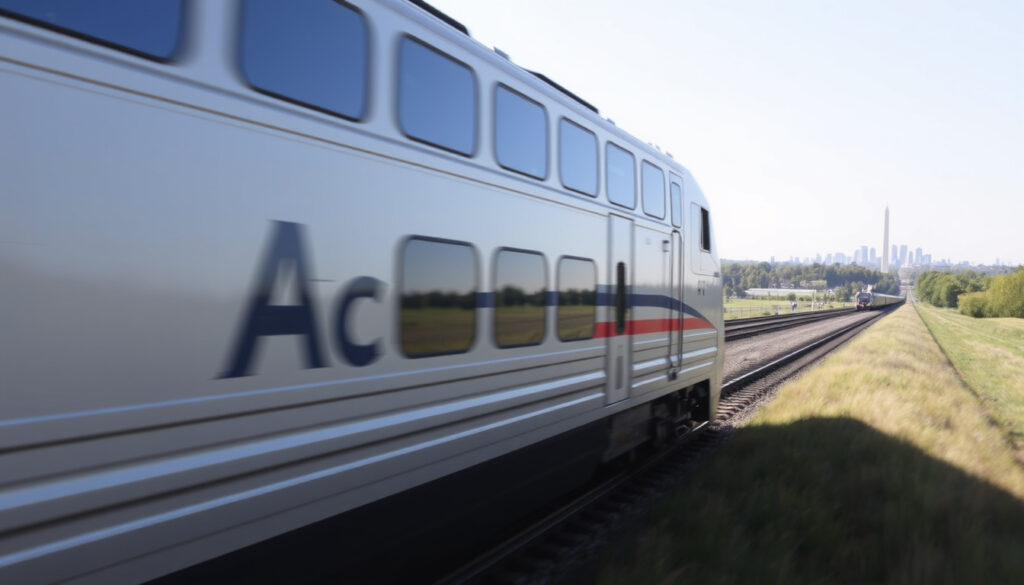
Train Times NYC to DC: Schedules, Costs & Fastest Routes
Anyone who’s stared at a New York Penn Station arrivals board on a Friday afternoon already knows the dilemma: do you sprint for the 4:30 or gamble on the 5:00? The New York City–Washington DC train corridor isn’t just the busiest passenger rail route in the United States—it’s a daily calculation of speed, cost, and convenience. Here’s how to navigate the 225-mile stretch with actual schedules, real price ranges, and the trade-offs that matter for different kinds of travelers.
Fastest train time: 2 hours 55 minutes (Acela) · Average travel time: 3 hours 30 minutes · Daily departures: 34 · Price range: $22 to $750 · Distance: 225 miles
Quick snapshot
- Amtrak Acela: 2h55m (Amtrak (official operator))
- Top speed 150 mph (Amtrak (official operator))
- Premium service with onboard amenities (Omio (route aggregator))
- Northeast Regional from $22 (Wanderu (route aggregator))
- Advance booking required (Amtrak (fare policy page))
- Slower: 3h30m–4h (Omio (route aggregator))
- Balance of speed and cost (Wanderu (route aggregator))
- Acela off-peak fares (Amtrak (fare policy page))
- Book 2+ weeks ahead (Amtrak (fare policy page))
- Exact ticket price varies by demand and booking time
- Future NextGen Acela top speed yet to be finalized
- Real-time schedule changes may occur
- Premium service amenities may differ by train
Five key numbers define this route, from operator to average cost.
| Label | Value |
|---|---|
| Fastest time | 2h55m (Acela) |
| Average cost | $50–$750 |
| Departures per day | 34 |
| Distance | 225 miles |
| Operator | Amtrak |
What is the fastest train from NYC to Washington DC?
The Amtrak Acela Express is the fastest rail option connecting New York Penn Station and Washington Union Station, with a scheduled travel time of approximately 2 hours and 55 minutes for most trips, according to Amtrak (official service provider).
How fast is the Amtrak Acela?
- Current maximum operating speed: 150 mph on certain Northeast Corridor segments (Amtrak (official operator))
- Average speed including station stops: roughly 75–85 mph
- Travel time NYC to DC: approximately 2h55m for standard Acela service
The nonstop Acela service launched in September 2019 originally offered a 2-hour 35-minute trip, departing New York at 6:35 a.m. and arriving in Washington around 9:10 a.m., as reported by Amtrak Media (corporate communications). As of 2025, that dedicated nonstop service has been folded into the regular Acela schedule, and the fastest standard Acela trip has settled at 2h55m.
What is the travel time for Northeast Regional?
- Northeast Regional trains: 3 hours 30 minutes to 4 hours (Omio (route aggregator))
- Comparable to driving time under ideal conditions
- Makes intermediate stops including Newark, Trenton, Philadelphia, Wilmington, and Baltimore
The Acela saves roughly 45 minutes compared to the Northeast Regional, but the value per minute diminishes once you factor in ticket price. For a business traveler billing at $100/hour, the saved time justifies a premium; for a leisure traveler, that 45 minutes may not be worth doubling the fare.
The implication: If your priority is absolute minimum time from Penn Station to Union Station, the Acela is your only play. But for most travelers, the Northeast Regional offers a solid 75% of the speed at a fraction of the cost.
How much does a train from NYC to DC cost?
Ticket prices on this corridor swing dramatically. A Northeast Regional Wanderu (route aggregator) lists a lowest fare teaser of $22, while an Acela ticket can reach $750. The gap reflects different services, booking timing, and demand.
What factors affect ticket prices?
Several variables influence the final ticket price.
| Factor | Impact on price |
|---|---|
| Service type (Acela vs Regional) | Acela is 2–4x more expensive |
| Advance booking | Early booking (2+ weeks) can cut price by 50–70% |
| Demand (peak vs off-peak) | Peak hours (Fri/Sun) can double price |
| Fare class (Saver vs Value vs Flexible) | Flexible tickets cost $50–$150 more |
| Time of day | Early morning and late evening cheaper |
How to find cheap Amtrak tickets?
- Book at least 14 days in advance for Saver fares (Amtrak (fare policy page))
- Sign up for Amtrak Guest Rewards emails for flash sales
- Travel on Tuesday, Wednesday, or Saturday for lowest demand
- Use the Amtrak app for last-minute deals on unsold seats
- Discount programs: seniors (10% off), students (15% off), military (10%), AAA members (10%) according to Amtrak (discount programs)
The pattern: The $22 fare is a marketing teaser for the Northeast Regional’s Saver bucket—actual availability on popular travel days is closer to $50–$80. The real bargain hunting begins when you’re flexible on timing and commit early.
Is it better to fly or take the train from NYC to DC?
This is the question every regular East Coast traveler has debated. The answer depends on which time and cost clock you use.
Time comparison: train vs flight
The door-to-door time comparison reveals a different picture.
| Metric | Train (Acela) | Flight (coach) |
|---|---|---|
| Scheduled travel time | 2h55m | 1h15m |
| Airport/station access time | 10–15 min from Midtown | 45 min to LGA/JFK/EWR |
| Security time | None (no TSA) | 30–60 min |
| Gate-to-gate arrival | Arrives downtown DC | Arrives DCA/IAD (then 30 min to DC) |
| Typical door-to-door | 3h30m–4h | 3h45m–5h |
The catch: A nonstop flight’s 75 minutes in the air doesn’t account for the hour of travel to the airport, the security queue, or the ride from Reagan National back to downtown DC. Amtrak (comparison page) notes that city-center to city-center travel often favors the train by 30–60 minutes when fully factored.
Cost comparison
- Train: $22–$750, no baggage fees, no seat selection fees
- Flight: $99–$400, plus $35–$60 for checked bag, $25–$40 for seat selection
- Train wins on cost for 1–2 checked bags; flight can win solo if you find a Google Flights (flight metasearch) deal under $100
The budget traveler who brings two checked bags and compares fares a week out will almost always find the train cheaper. The business traveler who values time above all may still prefer the Acela’s downtown-to-downtown efficiency over a flight that adds 90 minutes of transit at both ends.
What this means: For anyone based in Manhattan or midtown DC, the train’s door-to-door time is competitive with flying, and for most routes, the total travel time is shorter once you factor in airport logistics.
What are the train times from NYC to DC today?
Amtrak operates approximately 34 daily departures from New York Penn Station to Washington Union Station, with timing that spans early morning to late night.
Amtrak daily schedule overview
| Period | Departures | Frequency |
|---|---|---|
| Early morning (3:00 AM–7:00 AM) | 4 | ~every 60 min |
| Morning peak (7:00 AM–10:00 AM) | 6 | ~every 30 min |
| Midday (10:00 AM–4:00 PM) | 12 | ~every 30 min |
| Evening peak (4:00 PM–7:00 PM) | 8 | ~every 20–30 min |
| Late night (7:00 PM–11:28 PM) | 4 | ~every 45–60 min |
Data from Omio (route aggregator) confirms 34 total departures daily. The Amtrak Acela Route Timetable (official PDF) shows Acela-specific departures integrated into this schedule, with Acela trains concentrated during peak business travel hours.
First and last train times
- First train: approximately 3:00 AM (Northeast Regional)
- Last train: approximately 11:28 PM (per Rail Ninja (route summary))
- First Acela: approximately 5:00 AM
- Last Acela: approximately 8:30 PM
How to check live train times
- Amtrak (official schedule tool) — real-time status and seat availability
- Amtrak app — push notifications for delays and track changes
- Third-party aggregators (Omio, Wanderu, Rome2Rio) — static schedules for planning
- Station departure boards at NYP and WAS
The trade-off: The 3:00 AM train exists but is typically the Northeast Regional, not Acela. If you need the speed of Acela, the window narrows to roughly 5:00 AM–8:30 PM.
Is there a high speed train between New York and DC?
Yes—the Amtrak Acela Express is the high-speed rail service on the Northeast Corridor, operating at up to 150 mph on certain segments.
What is the Acela Express?
- High-speed tilting train built by Alstom
- Operates exclusively on the Northeast Corridor (Boston–Washington)
- First launched in 2000; current fleet has been in service since then
- Weekly ridership before COVID: approximately 60,000 passengers on NYC–DC segment
What is the top speed of Acela?
The current Acela fleet reaches a top operating speed of 150 mph on parts of the corridor, particularly in Massachusetts and Rhode Island, with slower speeds in the New York and Washington terminal areas due to track constraints. Amtrak (official description) notes that the average speed between NYC and DC, including station stops, is approximately 85 mph.
Future NextGen Acela
Amtrak’s next-generation Acela trainsets, built by Alstom and known as the Avelia Liberty, are expected to begin revenue service in late 2024 or 2025. These trains are designed to reach 160 mph and increase seating capacity by 25% per train. Amtrak Media (press release) states the new fleet will also feature improved accessibility, Wi-Fi, and onboard dining.
The implication: For travelers who compare Acela to TGV or Shinkansen, the US version is slower. But within the US, it is the fastest option, and the 2025 upgrades will close the gap modestly without achieving international-level speeds.
Pros and cons of taking the train NYC to DC
Upsides
- No TSA lines — arrive 10 minutes before departure
- Downtown-to-downtown — both Penn Station and Union Station are central
- Baggage included — two free carry-ons, no weight limit anxiety
- Reliable Wi-Fi and power outlets at every seat
- More legroom than airline economy class
- Scenic Hudson River and New Jersey coastline views
Downsides
- Slower than flight in the air (but not door-to-door)
- Acela fares can exceed $700 for last-minute flexible tickets
- Northeast Regional can be crowded and uncomfortable during peak hours
- Delays are common — Amtrak’s on-time performance on NEC was roughly 75% in 2023
- No food service on basic Northeast Regional trains (cafe car only on Acela)
- Limited late-night options — last departure around 11:28 PM
The train beats flying for most travelers between NYC and DC if you value simplicity, baggage, and downtown access over raw airspeed. But the $22–$750 price gap means the right choice shifts with your budget and schedule flexibility.
en.wikipedia.org, trainstracking.com, liveandletsfly.com, appassets.mvtdev.com, juckins.net, moovitapp.com
For travelers comparing options, NYC to DC train schedules provide a comprehensive overview of departure times and fare ranges.
Frequently asked questions
What is the cheapest way to get from NYC to DC?
The cheapest rail option is the Amtrak Northeast Regional Saver fare, which can drop to $22 when booked at least 14 days in advance, according to Amtrak (fare policy page). Bus services (Greyhound, FlixBus) can be cheaper at $10–$30 but take 4.5–6 hours.
Is Acela nicer than Amtrak Northeast Regional?
Yes. Acela offers wider seats, power outlets, cafe car, and a quieter ride with fewer intermediate stops. The Northeast Regional is a standard coach train with cramped seats and no food service on many runs. Amtrak (Acela page) positions it as a premium service.
What not to bring on Amtrak?
Amtrak prohibits firearms, explosives, flammable liquids, and large coolers. Check Amtrak (baggage policy) for the full prohibited items list. Bicycles are allowed with a reservation and $20 fee.
How far in advance should I book Amtrak?
For the best prices, book 14–30 days ahead. Saver fares become available when Amtrak releases its schedule (usually 11 months out), and prices rise as departure approaches. Amtrak (ticket fares page) recommends booking early for the lowest fares.
Are there overnight trains from NYC to DC?
No. The last train departs around 11:28 PM and the first at 3:00 AM, but there is no dedicated overnight sleeper service on this corridor. Overnight travelers should consider the Silver Star or Silver Meteor (Florida trains) that pass through but do not offer direct NYC–DC sleeper service.
Do I need to print my ticket?
No. Amtrak accepts e-tickets on the Amtrak app, on your phone, or at self-service kiosks at the station. Amtrak (ticket and travel page) states paper tickets are not required.
Can I bring a bike on Amtrak?
Yes, on select trains including Northeast Regional with a bike reservation ($10–$20 fee). Acela trains do not accept bikes. Amtrak (bicycle policy page) has complete details.
What is the baggage allowance on Amtrak?
Two free carry-on bags (up to 50 lbs each) and two free checked bags on most trains. Amtrak (baggage policy) allows oversized items with a fee.
Related reading
- United Airlines Flight Changes August 12: Policy Guide — for travelers comparing airline and train flexibility
- 2024 Tesla Model Y: Price, Specs, Range, and Review — for those considering driving vs train on the Northeast Corridor
For the traveler standing at Penn Station with a decision to make, the choice is clear: take the Acela if time is critical and budget allows; book a Northeast Regional Saver fare 14 days out if cost matters most; fly only when you find a $99 deal and have checked bags to spare. The Amtrak corridor delivers consistent, reliable service—but which train you choose shapes both your experience and your wallet.
More related posts
 S&P 500 News: 2026 Forecasts & Buffett Views
 How Tall is Caitlin Clark? Height, Weight & WNBA Stats
 Beau of the Fifth Column: Biography, News, and Personal Life
 How to Check Transmission Fluid: Step-by-Step Guide
 Google Doodles: Best Games, Easter Eggs & Hidden Features
 New Series to Watch 2026: Top Trending Shows Now
 What Does Doxxed Mean? Definition, Risks & Prevention
 Back to School Sales Ireland 2025: Best Deals & Shopping Guide
