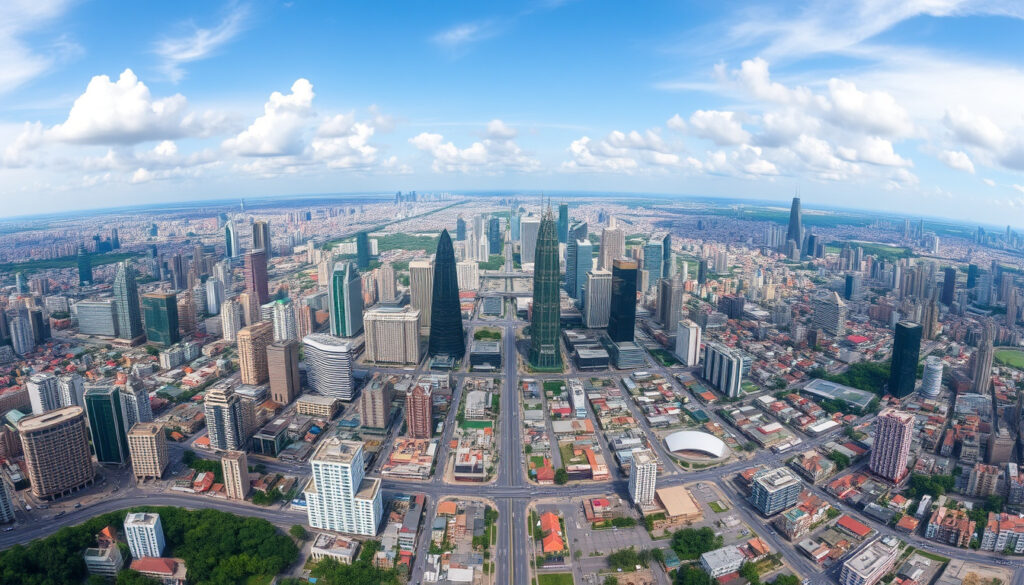
Most Populated City in the World: Jakarta Tops 2025 Rankings
Jakarta has overtaken Tokyo as the world’s most populous city, with 41.9 million residents in 2025, while Dhaka surges toward the top spot. The UN’s latest urbanization data reveals a dramatic shift in the global megacity hierarchy.
Current #1: Jakarta · #2: Dhaka · #3: Tokyo · Megacities: 33 in 2025 · 2050 #1: Dhaka at 52.1M
Quick snapshot
- Jakarta ranks #1 with 41.9 million residents (German Federal Statistical Office)
- Tokyo fell from #1 in 2000 to #3 in 2025 (Webull News)
- 33 megacities with 10+ million inhabitants in 2025 (UN Population Division)
- Exact 2026 rankings as agencies finalize 2025 actuals
- Guangzhou metro figures vary across sources (some cite 73.6M)
- Future of Japan’s population recovery programs
- UN WUP 2025 released November-December 2025 (UN DESA Voice)
- Dhaka growing at 42.3% per decade (Destatis)
- Number of cities worldwide doubled since 1975 (UN Sustainable Development)
- Dhaka projected to reach 52.1 million by 2050 (Destatis)
- 37 megacities expected by 2050 (Destatis)
- Tokyo to decline 8.1% to 30.7 million by 2050 (Destatis)
| Rank | City | Population (millions) | Trend |
|---|---|---|---|
| 1 | Jakarta, Indonesia | 41.9 | Rising |
| 2 | Dhaka, Bangladesh | ~40 | Fastest growth (+42.3%) |
| 3 | Tokyo, Japan | 33.4 | Declining from #1 |
| 4 | New Delhi, India | 30.2 | Rising (+12.3%) |
| 5 | Shanghai, China | 29.6 | Stable |
What are the 10 most populated cities in the world?
Current top 10 rankings
The UN World Urbanization Prospects 2025 data paints a clear picture: Asia dominates the list of most populous cities. Jakarta leads at 41.9 million, followed by Dhaka at nearly 40 million and Tokyo at 33.4 million (UN DESA Data Booklet). New Delhi sits fourth with 30.2 million, while Shanghai, Guangzhou, and Cairo round out the top seven.
Only Cairo breaks the Asian monopoly in the top 10, according to the UN Sustainable Development press release. The global picture now stands at 58% of the world’s 8.2 billion people living in urban areas, per the German Federal Statistical Office (Destatis).
Methodology for urban area populations
Here is where things get tricky. The UN uses “urban agglomeration” definitions — the continuous built-up area around a city — which tends to inflate numbers. Other sources, like Ontario Tech University, apply stricter boundaries that can produce wildly different rankings (Ontario Tech University). That university’s list puts Tokyo at 36.4 million as #1, with Jakarta absent from the top 20 entirely. The lesson: always check which definition a source uses before comparing figures.
A city appearing larger in one list and smaller in another usually reflects boundary definitions, not actual population disputes. Check whether numbers cover the “city proper” or the wider metropolitan area.
Where is the most populated city on Earth?
Tokyo’s current status
Jakarta now holds the title. The UN’s official data booklet confirms Indonesia’s capital as the world’s most populous city in 2025, with 41.9 million residents (UN DESA Data Booklet). Tokyo, which held the crown for decades after overtaking New York in the mid-20th century, has slipped to third place. Japanese media, reporting on the UN data, noted Tokyo’s remarkable descent from first in 2000 to third in 2025 (Webull News).
Urban agglomeration definitions
The discrepancy between rankings stems from how “city” is defined. The UN’s agglomeration approach captures the functional urban economy — the commute zone where people live and work — rather than arbitrary municipal borders. This inflates Jakarta’s count compared to sources counting only registered city residents. Both approaches are valid; they simply measure different things.
Infrastructure planning, economic policy, and resource allocation all depend on which population figure decision-makers reference. A city counted as 30 million faces different challenges than one counted as 42 million.
Is Tokyo no longer the world’s most populous city?
Recent shifts in rankings
Yes — and the shift is now official. According to the UN Sustainable Development press release, Jakarta leads with nearly 42 million residents, Dhaka follows with almost 40 million, and Tokyo trails at 33 million (UN Sustainable Development). Worldometers, a popular population tracker, independently lists Jakarta #1, Dhaka #2, and Tokyo #3 for 2025 (Worldometers).
Reasons for change
Several factors drive Tokyo’s decline. Japan’s overall population is shrinking due to low birth rates and an aging society. Even though Tokyo proper gained over 300,000 residents between 2015-2025, the metro area is expected to decline to 30.7 million by 2050 — an 8.1% drop, according to UN projections (Destatis). Meanwhile, Jakarta and Dhaka benefit from strong urbanization flows across Indonesia and Bangladesh, two of the world’s most densely populated nations.
“Cities are home to 45 per cent of the global population, with megacities continuing to grow.”
— UN DESA Voice, December 2025 feature on urbanization data
“Jakarta (Indonesia) is now the world’s most populous city, with nearly 42 million residents, followed by Dhaka (Bangladesh) with almost 40 million, and Tokyo (Japan) with 33 million.”
— UN Sustainable Development press release The UN Sustainable Development press release highlights Jakarta as the world’s most populous city, and you can find more details about the Google Pixel 10 Ireland price and specs at Google Pixel 10 Ireland.
Which city is expected to be largest in 2050?
UN projections
Dhaka is the undisputed future leader. The UN projects Bangladesh’s capital to reach 52.1 million by 2050, a 42.3% increase from its 2025 population (Destatis). The number of megacities globally will grow from 33 today to 37 by 2050, per the UN World Urbanization Prospects 2025 summary (UN Population Division).
Dhaka’s rise
Dhaka’s trajectory reflects Bangladesh’s broader urbanization boom. The country’s rural-to-urban migration shows no signs of slowing, and Dhaka absorbs the lion’s share. By 2050, the top six cities globally — Dhaka, Jakarta, Shanghai, New Delhi, Karachi, and Cairo — are all expected to be Asian or African megacities, with Tokyo falling to seventh place (Webull News).
Is the largest city also the most densely populated?
Population vs density
No — size and density are entirely different metrics. Dhaka, with around 40 million people spread across its urban area, faces immense density pressure, but other cities punch harder per square kilometer. Manila in the Philippines and parts of Manhattan in New York City exceed Dhaka’s density in localized zones. The distinction matters for urban planning: a city can be globally massive but locally manageable, or compact and locally overwhelming.
Top dense cities
When the conversation shifts to density rather than total population, cities like Manila, Dhaka, Karachi, and Mumbai appear near the top of different lists. The densest urban cores can exceed 70,000 people per square kilometer in some neighborhoods — orders of magnitude higher than the sprawling metro figures cited for Jakarta or Tokyo.
Related reading: Top Universities in the World
Jakarta edges out Tokyo in the Jakarta vs Tokyo 2025 matchup, as UN projections place Indonesia’s capital at 41.9 million residents for 2025.
Frequently asked questions
What is bigger, Tokyo or NYC?
By UN agglomeration figures, Tokyo (33.4 million) is roughly three times larger than New York City’s metro area (~20 million). However, definitions vary widely, and some NYC metropolitan rankings including parts of New Jersey and Connecticut can narrow the gap.
Which is the largest city in the world by area?
By physical land area, cities like New York, Tokyo, and São Paulo cover more territory than dense Asian megacities. But when measured by urban agglomeration — the continuous built-up zone — New York actually ranks among the world’s largest by land area despite having fewer residents than Jakarta or Dhaka.
What is the most densely populated city in the world?
Manila and Dhaka consistently rank among the world’s densest major cities, with some districts exceeding 70,000 people per square kilometer. Density rankings vary by whether they measure city proper, metropolitan area, or neighborhood-level data.
What is the least populated city in the world?
The world’s smallest recognized cities include places like Vatican City (~800 residents) or Hum in Croatia (~20 residents). However, definitions of what qualifies as a “city” vary dramatically by country, making precise rankings difficult.
Most populated city in the world in order?
The 2025 UN ranking places Jakarta first (41.9M), Dhaka second (~40M), Tokyo third (33.4M), New Delhi fourth (30.2M), and Shanghai fifth (29.6M), with Guangzhou, Cairo, Mumbai, Beijing, and Osaka rounding out the top 10.
What are the top 10 largest cities by area?
When ranked by physical land area, New York, Tokyo, and São Paulo typically appear at the top. These sprawling metros cover thousands of square kilometers even though their density figures are lower than compact Asian capitals.
How many megacities exist in 2025?
33 cities have populations exceeding 10 million as of 2025, per the UN World Urbanization Prospects 2025. Asia hosts 19 of these megacities. The count is projected to reach 37 by 2050.
More related posts
 Dresses for Wedding Guests: The Complete Ireland Guide
 Memphis Grizzlies vs Cleveland Cavaliers Match Player Stats – 2024 Box Scores & Highlights
 Jeff Daniels Movies and TV Shows: Complete Filmography Guide
 Mexico vs Uruguay Lineups – Predicted XIs, Team News & Injuries
 Buffalo Bills vs Baltimore Ravens Match Player Stats 2025
 Def Jam Fight for NY: Can You Still Play It in 2025
 Best Arepa de Choclo Near Me – Restaurants Delivery and Tips
 Train Times NYC to DC: Schedules, Costs & Fastest Routes
