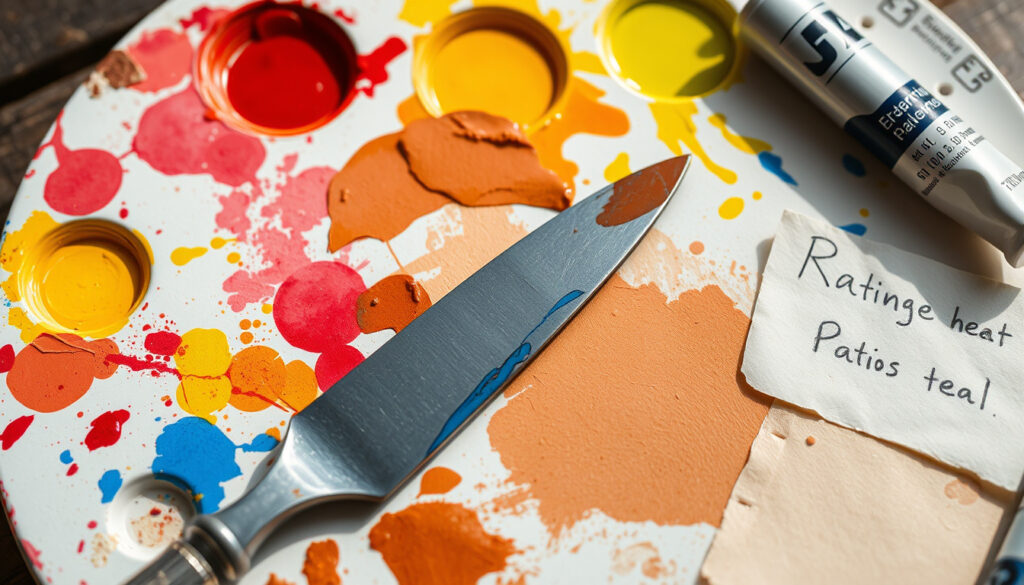
How to Make Brown Paint: Easy Mixing Tips and Ratios
Every painter hits the moment—sometimes before a landscape, sometimes while matching a wall color—when they realize they don’t actually know how to make brown. It feels like it should be simple, yet the first attempt often lands somewhere between gray sludge and a muddy mess. This guide cuts through the guesswork with concrete ratios, complementary pair logic, and the specific adjustments that turn a failed brown into the exact shade you need.
Number of primary colors used to mix brown: 3 (red, yellow, blue) ·
Number of complementary color pairs producing brown: 3 (blue+orange, red+green, yellow+purple) ·
Typical ratio for a medium brown: 2 parts red, 1 part yellow, 1 part blue ·
Approximate RGB value of standard brown: 165, 42, 42
Quick snapshot
- Mixing primary colors in unequal ratios yields brown (Craftsy craft education platform).
- Complementary colors mixed together produce brown (Michele Clamp Art artist teaching resource).
- Adding black deepens brown; adding white lightens it (The Virtual Instructor art education site).
- Exact ratio for a specific shade varies with pigment brand and medium (Acrylic Pouring acrylic painting guide).
- Whether a particular complement pair yields a “true” brown depends on pigment purity (The Virtual Instructor art education site).
- Color theory is fixed; brown-mixing techniques haven’t changed fundamentally for centuries (Craftsy craft education platform).
- New 2024 digital resources now include interactive color-mixing tools and video tutorials (YouTube Chris Breier art education channel).
- Apply your brown to painting projects; adjust with white or black for tinting/shading (Acrylic Pouring acrylic painting guide).
- Practice mixing from complementary pairs to control hue without using black (Michele Clamp Art artist teaching resource).
Brown isn’t a single hue—it’s a family of low-saturation colors. Anyone following a one-recipe guide risks getting the wrong shade for their specific project. The real skill is learning to adjust ratios, not memorizing a formula.
What Two Colors Make Brown?
When someone asks “what two colors make brown,” they’re usually looking for a shortcut—and the answer is a complementary pair. Three main pairs work: blue and orange, red and green, and yellow and purple. Each produces a distinct brown based on which side of the wheel dominates (Craftsy craft education platform).
Blue and Orange
- Mixing ultramarine blue with cadmium orange yields a neutral, medium-dark brown.
- More orange shifts the brown warmer; more blue makes it cooler (Michele Clamp Art artist teaching resource).
Red and Green
- Alizarin crimson mixed with sap green produces a rich, dark brown similar to burnt umber.
- This pair naturally creates brown without any yellow in the mixture, ideal for earthy tones (The Virtual Instructor art education site).
Yellow and Purple
- Cadmium yellow light mixed with dioxazine purple gives a lighter, warm brown with a golden undertone.
- Add more purple to darken, more yellow to lighten toward tan (Craftsy craft education platform).
The pattern is consistent: each complementary pair cancels the colorfulness of the other, leaving a neutral or near-neutral. The catch: pigment brands vary in strength, so the same ratio with different brands can give different results.
How Do You Make the Color Brown?
For projects where you don’t have a complementary color on hand, mixing from the three primaries—red, yellow, and blue—is the most reliable method. The logic is simple: primary colors mixed in unequal amounts cancel each other’s brightness and produce a low-saturation brown (Craftsy craft education platform).
Mixing Primary Colors
Place approximately equal amounts of red, yellow, and blue on a palette, then mix with a palette knife until the color becomes brown. Start with a ratio of 2 parts red to 1 part yellow to 1 part blue for a standard medium brown (Acrylic Pouring acrylic painting guide).
Adjusting Ratios for Desired Shade
- Add more yellow for a warmer, golden-brown (like ochre).
- Add more blue for a cooler, gray-brown (like taupe).
- Add more red for a reddish-brown (like burnt sienna) (The Virtual Instructor art education site).
- Add white for a lighter, more opaque brown (Craftsy craft education platform).
The trade-off: using too much black or too much blue can make the brown look dead and muddy rather than rich. The better approach is to adjust the primary ratio first, then tweak with small additions of white or black.
How to Make Dark Brown by Mixing Two Colors
Dark brown is not the same as “brown plus black.” It has depth and richness that come from using complementary pairs with darker pigments, not from muddling the mix with black (YouTube Chris Breier art education channel).
Using Black with a Color
- Start with orange (red + yellow mixed first), then add a small amount of black—about 5–10% of the total volume.
- This gives a deep, warm dark brown. Avoid black above 15%, which risks a flat, lifeless brown (Michele Clamp Art artist teaching resource).
Mixing Dark Complementary Pairs
- Use dark blue (ultramarine) with a strong orange (cadmium orange) in a ratio of 2:1 blue to orange.
- This yields a deep, cool dark brown similar to dark chocolate (Craftsy craft education platform).
- For a warm dark brown, start with red and add ultramarine blue in small increments, testing each addition (YouTube Chris Breier art education channel).
Why this matters: dark brown made from complementary pairs retains a subtle chromatic variance that “brown + black” lacks. It reads as richer and more natural in paintings and design work.
How to Make Brown Without Yellow
If you’ve run out of yellow or prefer not to use it—for example, in a project where a golden undertone would clash—the complement pairs red+green or blue+orange both produce brown without any yellow pigment in the mix (The Virtual Instructor art education site).
Using Red and Green
- Mix alizarin crimson with sap green in a 1:1 ratio for a dark, neutral brown.
- Adjust toward reddish or greenish brown by shifting the ratio 2:1 in favor of either (Craftsy craft education platform).
Using Blue and Orange
- Cadmium orange with ultramarine blue in equal parts gives a balanced, medium-dark brown.
- This method works regardless of whether you consider orange to “contain” yellow—the physics of the mix doesn’t require yellow paint on your palette (Michele Clamp Art artist teaching resource).
The pattern: both methods rely on complementary color pairs that, when mixed, cancel the dominant chroma of each hue. The result is a brown that reads as more neutral than a primary-based mix.
When mixing red and green, the specific green pigment matters. A cool green (like phthalo green) will produce a cooler, slightly blue-brown, while a warm green (sap green) yields a warmer, earthier brown. Test your specific pigments before committing to a large batch.
How to Make a Natural Brown Color?
Natural browns mimic the organic tones found in soil, wood, and earth. Unlike synthetic mixes that can look flat or plastic, natural browns have subtle undertones that shift depending on the pigment source (The Virtual Instructor art education site).
Using Earth Pigments
- Umber (raw or burnt): a dark, cool brown with greenish undertones.
- Sienna (raw or burnt): a warm, reddish-brown.
- Ochre: a light, yellowish-brown.
- Mix any of these with white for natural tan tones, or with black for deep browns (Craftsy craft education platform).
Mixing with Natural Dyes
- Strong coffee or black tea creates a translucent brown for watercolor or fabric dye.
- Walnut husk extract produces a rich, permanent brown for ink or stain.
- Combine these with a binder (gum arabic for watercolor, linseed oil for oil paint) for a DIY natural color (Michele Clamp Art artist teaching resource).
The trade-off: natural browns from earth pigments are more muted and less punchy than synthetic mixtures. That’s precisely what makes them desirable for realistic landscapes, portraits, and organic design work. For projects needing high chroma, stick with primary-based mixes.
Step-by-Step: Mixing Brown for Any Medium
Regardless of whether you work with acrylics, oils, watercolor, or digital, the core process is the same. These steps apply across media, though the specific behavior of each medium varies (Craftsy craft education platform).
- Prepare your tools. Palette, palette knife, paintbrush, test surface, water, and paper towels. For watercolor, use a mixing well instead of a palette (Acrylic Pouring acrylic painting guide).
- Choose your method. Decide between primary mix (red, yellow, blue) or complementary mix (e.g., blue+orange). For beginners, the primary method is more intuitive (Michele Clamp Art artist teaching resource).
- Start with small quantities. Mix small amounts first and test between additions so you can adjust warmer or cooler without wasting paint (Acrylic Pouring acrylic painting guide).
- Test on a swatch. Apply a small dab to paper or canvas—the color can look different on palette vs. surface.
- Adjust ratio incrementally. Add white for lighter, black or dark blue for darker. Add small pinches of red, yellow, or blue to shift temperature (The Virtual Instructor art education site).
- Mix with medium if needed. After the desired color is reached, mix with a medium of choice (linseed oil for oils, water for watercolor, acrylic medium for acrylics) (Acrylic Pouring acrylic painting guide).
The catch: every change in ratio changes not just the hue but also the opacity and drying characteristics. Acrylics dry darker than they appear wet; watercolors dry lighter. Always test your final mix on the actual surface.
Confirmed facts
- Mixing primary colors in unequal ratios yields brown (Craftsy craft education platform).
- Complementary colors mixed together produce brown (Michele Clamp Art artist teaching resource).
- Adding black deepens brown; adding white lightens it (The Virtual Instructor art education site).
- Brown is a family of low-saturation colors, not a single hue (The Virtual Instructor art education site).
- Earth pigments (umber, sienna, ochre) provide natural browns (Craftsy craft education platform).
What’s unclear
- Exact ratio for a specific shade varies with pigment brand and medium (Acrylic Pouring acrylic painting guide).
- Whether a particular complement pair yields a “true” brown depends on pigment purity (The Virtual Instructor art education site).
- The specific green pigment used in red+green mixes changes the brown temperature (Michele Clamp Art artist teaching resource).
“When complementary colors are mixed together, they neutralize each other and produce a neutral or near-neutral color, such as brown.”
— Color: A Workshop for Artists and Designers (color theory textbook)
“The ratio and specific pigments determine the neutral color produced when mixing primary colors. It’s not a fixed formula; it’s a relationship.”
— The Virtual Instructor (art education site)
“Start with equal parts red, yellow, and blue, then add white, red, yellow, or blue in tiny increments to shift temperature and value.”
— Acrylic Pouring (acrylic painting guide)
“Brown can be made from traditional red, yellow, and blue primaries, and also from CMY printing primaries.”
— Chris Breier (art education channel via YouTube)
The editorial verdict: mixing brown isn’t a single recipe—it’s a process. For acrylic and oil painters, investing time in learning ratio adjustments pays off faster than searching for a pre-mixed brown that fits the scene. For watercolorists and digital artists, understanding the complementary pairs gives more control than relying on the default “brown” swatch.
Can you make brown with only two colors?
Yes. Mixing complementary colors (blue+orange, red+green, or yellow+purple) produces brown with just two colors (Craftsy craft education platform).
What color neutralizes brown in a mix?
Adding the opposite color on the color wheel neutralizes the hue. For a warm brown, add blue; for a cool brown, add red or yellow (The Virtual Instructor art education site).
How to make light brown paint?
Start with a medium brown (2 parts red, 1 part yellow, 1 part blue) and add white paint in small increments until you reach the desired lightness (Craftsy craft education platform).
How to make brown with watercolors?
Watercolors are transparent, so mix primary colors on a palette or in a mixing well. Use less water for a darker brown; add more water and a touch of yellow for a translucent golden brown (Michele Clamp Art artist teaching resource).
Why does my brown look greenish?
Too much blue or green in the mix relative to red creates a greenish-brown. Add a small amount of red to cancel the green bias (Acrylic Pouring acrylic painting guide).
How to make brown from primary colors without black?
Mix red, yellow, and blue in unequal ratios—start with 2:1:1—then adjust until you get a brown that doesn’t need blackening. Using dark pigments (ultramarine blue, alizarin crimson) yields a darker brown naturally (The Virtual Instructor art education site).
What is the difference between umber and sienna?
Umber is a dark, cool brown with greenish undertones due to higher manganese content. Sienna is warmer and redder, containing more iron oxide. Both are natural earth pigments (Craftsy craft education platform).
For the painter staring at a palette full of unmixed colors, the choice is clear: understand the ratio process and the complementary pairs, or rely on a pre-mixed brown that may never match the light and mood of the scene in front of you. The former gives control; the latter gives convenience. One session of ratio experimentation will teach you more than a dozen store-bought tubes ever will.
Related reading: How to Draw a Girl – Easy Step-by-Step Tutorial for Beginners · Charlotte Tilbury Pillow Talk: Iconic Nude-Pink Lipstick Guide
More related posts
 Where to Watch The White Lotus: Streaming Guide 2025
 The Most Dangerous Game: Where to Watch, Story Summary, and Cast
 No Location Found on iPhone: Meaning and Fixes
 Best Meal Delivery Service 2026: Reviews & Cheaper Alternatives
 Kentucky Wildcats Basketball 2025: Odds, Roster & Schedule
 Nick Kroll Movies and TV Shows: The Complete Guide (2025)
 GLP-1 News Today: Pancreatitis Warnings & New Weight Loss Pills
 154 cm in Feet: Conversion, Context, and Height Insights
