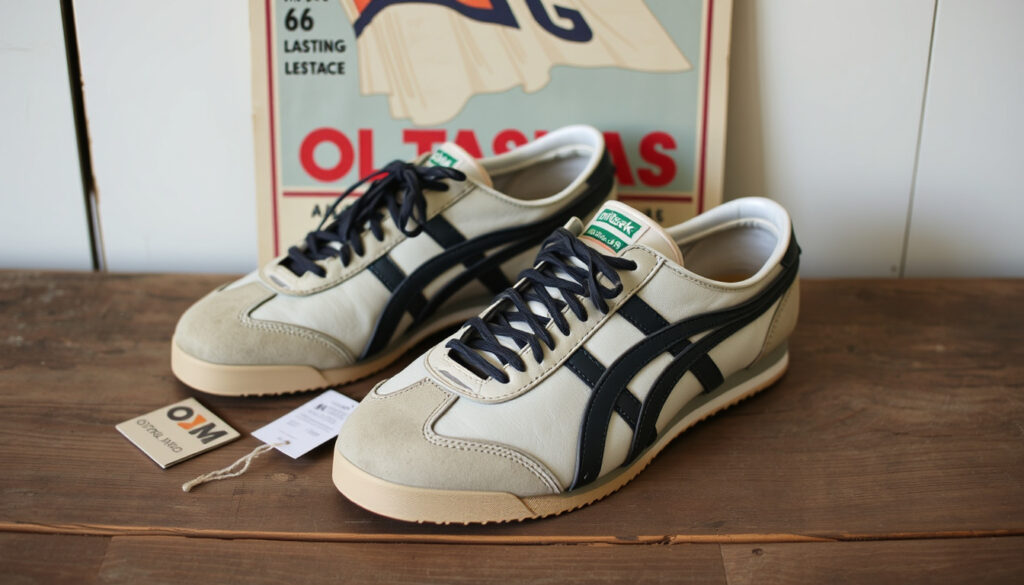
Onitsuka Tiger Mexico 66: History, Price, and Legacy
There’s a reason why a sneaker born on the track in the 1960s still pops up in fashion editorials and movie scenes more than half a century later — the Onitsuka Tiger Mexico 66 first appeared in 1966, gained fame after Bruce Lee wore a similar pair in Game of Death, and its clean silhouette turned it into a cultural icon. Originally a performance shoe for Japan’s Olympic team, this piece walks through its history, price tag, and why it now sits at the intersection of sport and luxury.
Year introduced: 1966 ·
Named after: 1968 Mexico City Olympics ·
Parent company: ASICS ·
Iconic wearer: Bruce Lee ·
Original purpose: Performance sneaker
Quick snapshot
- Released in 1966 (Wikipedia)
- Named after the 1968 Mexico City Olympics (Tatler Asia)
- Owned by ASICS since 1977 (Onitsuka Tiger UK Brand History)
- Exact production numbers for specific colorways
- Future collaboration plans
- Profit margin breakdown for the shoe
- 1949 – Onitsuka Tiger founded in Kobe, Japan (Tatler Asia)
- 1966 – Mexico 66 model released (Wikipedia)
- 1977 – Merger forms ASICS (Onitsuka Tiger UK Brand History)
- Continued focus on lifestyle and luxury positioning
- Possible limited-edition drops and brand collaborations
- Sustained interest from retro-sneaker collectors
The six key facts below summarise the essential data points every buyer should know.
| Attribute | Value | Source |
|---|---|---|
| First released | 1966 | Wikipedia |
| Named after | 1968 Mexico City Olympics | Tatler Asia |
| Parent brand | ASICS | Wikipedia |
| Iconic stripes | Introduced in 1966 | Onitsuka Tiger UK Brand History |
| Price range | €100 – €200 | Onitsuka Tiger UK Brand History (positions as premium lifestyle) |
| Famous wearer | Bruce Lee | Wikipedia |
What is so special about Onitsuka Tiger Mexico 66?
Design and iconic stripes
The Mexico 66’s most recognisable feature is its side stripe. According to Onitsuka Tiger UK Brand History (the brand’s official site), the stripe first appeared in 1966 on the LIMBER UP Leather BK, a model created for the 1968 Mexico City Olympics. The clean, retro silhouette with a suede toe cap and low-profile sole has changed little since, which is part of its appeal.
Comfort and craftsmanship
The shoe was originally designed as a running shoe for Japan’s Olympic team, as noted by Tatler Asia (a style and culture publication). The brand’s founder, Kihachiro Onitsuka, had a breakthrough in 1960 after observing how hot water wrinkled his toes in the bath, leading to better air circulation in the MAGIC RUNNER (Onitsuka Tiger UK Brand History). That spirit of innovation carries into the Mexico 66, which uses premium rubber and padded insoles for all-day wear.
The Mexico 66 is not a tech-loaded performance shoe today — it’s a lifestyle sneaker that prioritises style and heritage over cutting-edge sport function. Buyers who want modern cushioning may prefer ASICS’ Gel line; those who want a piece of sneaker history will love the Mexico 66.
Cultural impact and celebrity endorsements
Bruce Lee wore a similar yellow-and-black pair in the 1978 film Game of Death, and the shoe received another boost from Kill Bill: Volume 1, according to Wikipedia. This pop-culture lineage, combined with high-fashion collaborations (e.g., with Valentino), has cemented the Mexico 66 as a streetwear staple. The implication: its cultural resonance drives demand far beyond the running track.
Why is Onitsuka Tiger expensive?
Materials and construction
Onitsuka Tiger positions itself as a premium lifestyle brand, and the Mexico 66 reflects that. While exact material specs are not detailed publicly, the brand’s official history emphasises Japanese design heritage and quality craftsmanship (Onitsuka Tiger UK Brand History). The use of full-grain leather, suede overlays, and vulcanised rubber outsoles is in line with other €100–€200 sneakers.
Brand heritage and exclusivity
The Onitsuka Tiger label, relaunched globally in 2002 (Onitsuka Tiger UK Brand History), deliberately targets a higher price tier than its sister brand ASICS. Limited-edition colourways and collaborations with designers like Valentino push prices even higher, though exact retail markups remain unclear. The trade-off: you pay for the story and the street cred, not just the leather.
Comparison to other luxury sneakers
One of the most frequent comparisons is with the ASICS Gel-Lyte III, a retro runner that sells for roughly €100–€150. The Mexico 66 commands a slight premium thanks to its older lineage and tighter association with Japanese luxury. Below is a quick brand comparison.
| Feature | Onitsuka Tiger Mexico 66 | ASICS Gel-Lyte III |
|---|---|---|
| Year introduced | 1966 | 1990 |
| Target use | Lifestyle / fashion | Lifestyle / retro running |
| Iconic feature | Side stripes, suede toecap | Split tongue, Gel cushioning |
| Price range (retail) | €100 – €200 | €100 – €150 |
| Parent company | ASICS | ASICS |
The pattern: both sit under the same corporate umbrella, but Onitsuka Tiger commands a higher average price because of its 1960s pedigree and luxury repositioning. For a buyer in Ireland, the Mexico 66 is the more fashion-forward choice; the Gel-Lyte III offers similar retro vibes at a slightly lower cost.
Are Asics and Onitsuka the same?
Origins of Onitsuka Tiger and ASICS
Onitsuka Tiger was founded in 1949 by Kihachiro Onitsuka in Kobe, Japan, as a basketball shoe company (Tatler Asia). The brand quickly moved into running shoes. In 1977, Onitsuka Tiger merged with two other companies to form ASICS, an acronym for the Latin phrase “Anima Sana In Corpore Sano” (a sound mind in a sound body) (Onitsuka Tiger UK Brand History).
The 1977 merger that created ASICS
The merger united Onitsuka Tiger, GTO Co., and JELENK Co., combining expertise in shoes and apparel. After 1977, ASICS became the main brand for performance athletic shoes, while Onitsuka Tiger continued as a standalone line within the group.
Onitsuka Tiger today as a separate line under ASICS
Today, Onitsuka Tiger UK Brand History describes the label as “a lifestyle brand that revives classic models”. The Mexico 66 serves as its flagship. ASICS handles performance running, court sports, and training. So they are not the same — but they share DNA.
If you buy an Onitsuka Tiger sneaker, you are supporting the same parent company as ASICS, but you are paying extra for the heritage badge and luxury aesthetic. The underlying technology is simpler than a modern ASICS running shoe.
The implication: for shoppers weighing brand identity, the distinction matters more for lifestyle perception than for corporate ownership.
Is Onitsuka a luxury brand?
Pricing tier and market segment
Onitsuka Tiger’s official site presents the brand as “premium lifestyle” (Onitsuka Tiger UK Brand History). With retail prices from €100 to €200, it sits at the lower end of luxury sneaker pricing, alongside brands like Veja and Common Projects, and above mass-market athletic brands. It does not reach the €500+ tier of Gucci or Balenciaga, but its exclusivity and retro cachet give it a luxury aura.
Celebrity and fashion endorsement
High-fashion collaborations, such as the Valentino partnership, further boost its luxury credentials. The brand also invests in limited drops and curated colourways. According to Tatler Asia, the Mexico 66’s association with the 1968 Olympics and its minimalist design make it a favourite among tastemakers.
Comparison with traditional luxury houses
The Mexico 66 does not use exotic materials or hand-stitching on the level of true luxury houses. Instead, it relies on design heritage and scarcity. For the buyer in Ireland, the question is: are you paying for Japanese craftsmanship or for the label? The answer is both — but with an emphasis on the story.
Why is it called Mexico 66?
The 1968 Mexico City Olympics connection
Tatler Asia states that the Mexico 66 was designed for the Japan team ahead of the 1968 Summer Olympics in Mexico City. The name combines the host city (Mexico) with the year of the shoe’s debut (1966).
The 1966 release year
The “66” explicitly refers to 1966, the year the model was first sold (Wikipedia). This is a common naming trick in sneakers — the model is named after a future event, with the year of introduction in the name. The 1968 Olympics were still two years away when the shoe hit shelves.
Evolution of the name over decades
After the 2002 global relaunch, the shoe was officially reissued under the “MEXICO 66” name. Onitsuka Tiger’s 75th anniversary page notes that the first-generation reissue was based on an archival pair (Onitsuka Tiger 75th Anniversary (brand’s official history)). The name has remained unchanged, and the shoe looks nearly identical to the 1966 original.
Timeline
The key milestones below trace the Mexico 66’s evolution from Olympic track shoe to lifestyle icon.
| Date | Event |
|---|---|
| 1949 | Onitsuka Tiger founded in Kobe, Japan (Tatler Asia) |
| 1966 | Mexico 66 model released (Wikipedia) |
| 1968 | Worn at Mexico City Olympics (Tatler Asia) |
| 1977 | Onitsuka Tiger merges to form ASICS (Onitsuka Tiger UK Brand History) |
| 1978 | Bruce Lee wears Mexico 66 in Game of Death (Wikipedia) |
| 2002 | Global relaunch of Onitsuka Tiger lifestyle line (Onitsuka Tiger UK Brand History) |
The pattern: the timeline shows a shoe that moved from athletic performance to cultural iconography, with each decade adding a new layer of meaning.
Clarity: What we know vs. what remains uncertain
Confirmed facts
- Mexico 66 released in 1966 (Wikipedia)
- Onitsuka Tiger is owned by ASICS (Onitsuka Tiger UK Brand History)
- The shoe was named after the 1968 Olympics (Tatler Asia)
- Bruce Lee wore the Mexico 66 (Wikipedia)
What’s unclear
- Exact production numbers for specific colorways
- Future collaboration plans
- Profit margin breakdown for the shoe
- Detailed materials sourcing and manufacturing locations
The core historical and brand facts are solid. Details around supply chain, future drops, and profitability are not publicly available. For a buyer, the confirmed facts are enough to make an informed decision — the rest is part of the brand’s mystique.
What this means: buyers can trust the heritage story while acknowledging that some claims about exclusivity are intentionally opaque.
Quotes from key sources
“The Mexico 66 retains the feel of the 1960s and remains an Onitsuka Tiger icon.”
— Onitsuka Tiger UK Brand History (the brand’s official site)
“Onitsuka Tiger was founded in 1949 and merged to form ASICS in 1977.”
— Wikipedia (the free encyclopedia)
“The Mexico 66 was originally designed as a running shoe for the 1968 Mexico Olympic Games.”
— Tatler Asia (a style and culture publication)
“The first-generation MEXICO 66 launched in 2002, based on an archival pair.”
— Onitsuka Tiger 75th Anniversary (brand’s official history)
These four perspectives — from the brand itself, an encyclopedia, a style publication, and the brand’s anniversary microsite — paint a consistent picture of the Mexico 66’s heritage and modern significance.
Summary: what the Mexico 66 means for Irish buyers
The Onitsuka Tiger Mexico 66 is not the cheapest sneaker, nor the most technologically advanced. It is a carefully preserved piece of design history that has been repositioned from Olympic track to luxury streetwear. Its price reflects heritage, Japanese craftsmanship, and cultural cachet — not raw material cost. For shoppers in Ireland, the choice is clear: if you want a conversational, retro sneaker with a genuine 1966 pedigree, the Mexico 66 delivers. If you need modern comfort or a lower price, ASICS’ own Gel line offers a practical alternative without the prestige.
Pros and cons
Upsides
- Genuine 1960s heritage with cultural cachet from Bruce Lee and film appearances
- Japanese craftsmanship with premium leather, suede, and vulcanised rubber
- Timeless silhouette that remains largely unchanged since 1966
- Entry-level luxury pricing (€100–€200) below traditional designer sneakers
Downsides
- Lacks modern running-shoe cushioning for all-day athletic wear
- Standard models use leather and suede — not vegan-friendly
- Narrow fit may require sizing up for wider feet
- Premium over sister brand ASICS is largely for heritage badge, not technology
For those curious about the factors behind its cost, a detailed breakdown of why the Mexico 66 commands such a price offers further insight.
Frequently asked questions
How should I clean my Onitsuka Tiger Mexico 66?
Use a soft brush and mild soap on the uppers. Avoid machine washing. The outsole can be wiped with a damp cloth. For suede sections, a suede eraser is recommended (brand care guidelines).
Are Onitsuka Tiger shoes comfortable?
Yes, for casual wear. The padded collar and cushioned insole provide reasonable comfort for daily use, though the shoe lacks modern running-shoe cushioning like Gel or Boost technology.
Does Onitsuka Tiger Mexico 66 run small?
Most buyers find the Mexico 66 true to size, but there are reports that the narrow fit may require going half a size up for wider feet. Check a size guide before ordering.
Where is Onitsuka Tiger Mexico 66 made?
Manufacturing locations vary by model and production run. The brand does not publicly disclose factory locations, but many Onitsuka Tiger sneakers are made in Vietnam or Indonesia. The design and development remain in Japan.
Is Onitsuka Tiger Mexico 66 good for walking?
Yes, for light to moderate walking. The rubber outsole offers decent grip, and the leather/suede upper provides durability. For long distances, consider a modern walking shoe.
What is the difference between Onitsuka Tiger and ASICS shoes?
Onitsuka Tiger is a lifestyle brand under the ASICS group, focusing on retro fashion models like the Mexico 66. ASICS produces performance athletic shoes for running, tennis, and training. Price points overlap but Onitsuka Tiger generally commands a premium.
Are Onitsuka Tiger Mexico 66 vegan?
The standard Mexico 66 uses leather and suede, so it is not vegan. Some colourways may use synthetic materials — check the product details on the official site.
More related posts
 Pictures of Boils on Private Area: Visual Guide & Treatment
 United Airlines Flight Changes August 12: Policy Guide
 Arm Tattoos: Guide for Men, Women, and Meaningful Designs
 Odessa A’zion Movies & TV Shows: Full Filmography
 The Karate Kid 2 Film: Guide to Part II and 2025 Reboot
 Hyundai N Vision 74: Specs, Price, Release Date 2026
 Snow White 2025 Showtimes: Guide, Age Rating, Reviews
 Minions: The Rise of Gru Cast – Full Voice Cast and Characters
